 Otter Marine
Preparing Your Boat for a Catalina Trip from Marina del Rey
A Marina del Rey pre-departure guide covering engine reliability, fuel, cooling, electrical systems, sea trials, weather, and safe go-or-no-go decisions.
By Otter Marine Published August 13, 2026
The short answer
Resolve every meaningful engine symptom before leaving Marina del Rey, plan fuel from proven consumption with a reserve, inspect cooling and charging systems, and perform a loaded local sea trial. Verify the current marine forecast and harbor conditions immediately before departure, and postpone when the boat, crew, or weather is not ready.
Prepare for the conditions outside the basin
A boat can idle smoothly in a protected Marina del Rey basin and still develop fuel starvation, overheating, charging loss, vibration, or control problems after sustained operation. Begin with the symptoms and service history rather than the planned departure date. A hard start, intermittent alarm, unexplained fluid loss, or recent power change should be diagnosed before the crossing.
Review the official engine schedule by both time and operating hours. Confirm what was completed, not what a seller or prior owner thought was probably done. Impellers, filters, belts, hoses, anodes, batteries, and aging fuel can be due even on a low-hour boat that spends most of the year in its slip.
Check the complete fuel path
Know the usable capacity of each tank, the valve arrangement, the engine's demonstrated consumption, and the reserve required for changing conditions. A gauge reading is only one input. Loading, sea state, current, hull condition, speed, and detours all influence range, and a restricted vent or contaminated filter can stop an engine while fuel remains aboard.
Inspect fills, caps, vents, accessible hoses, clamps, filters, primer components, and the bilge for fuel odor. If the boat has been stored, do not assume adding fresh fuel corrects old or water-contaminated fuel. Sample or service the system by an appropriate method before relying on it offshore.
- Verify tank selection and shutoff positions
- Calculate from proven consumption
- Carry approved spares and know their safe use
- Stop and ventilate if fuel odor or leakage is present
Inspect raw-water and closed-cooling systems
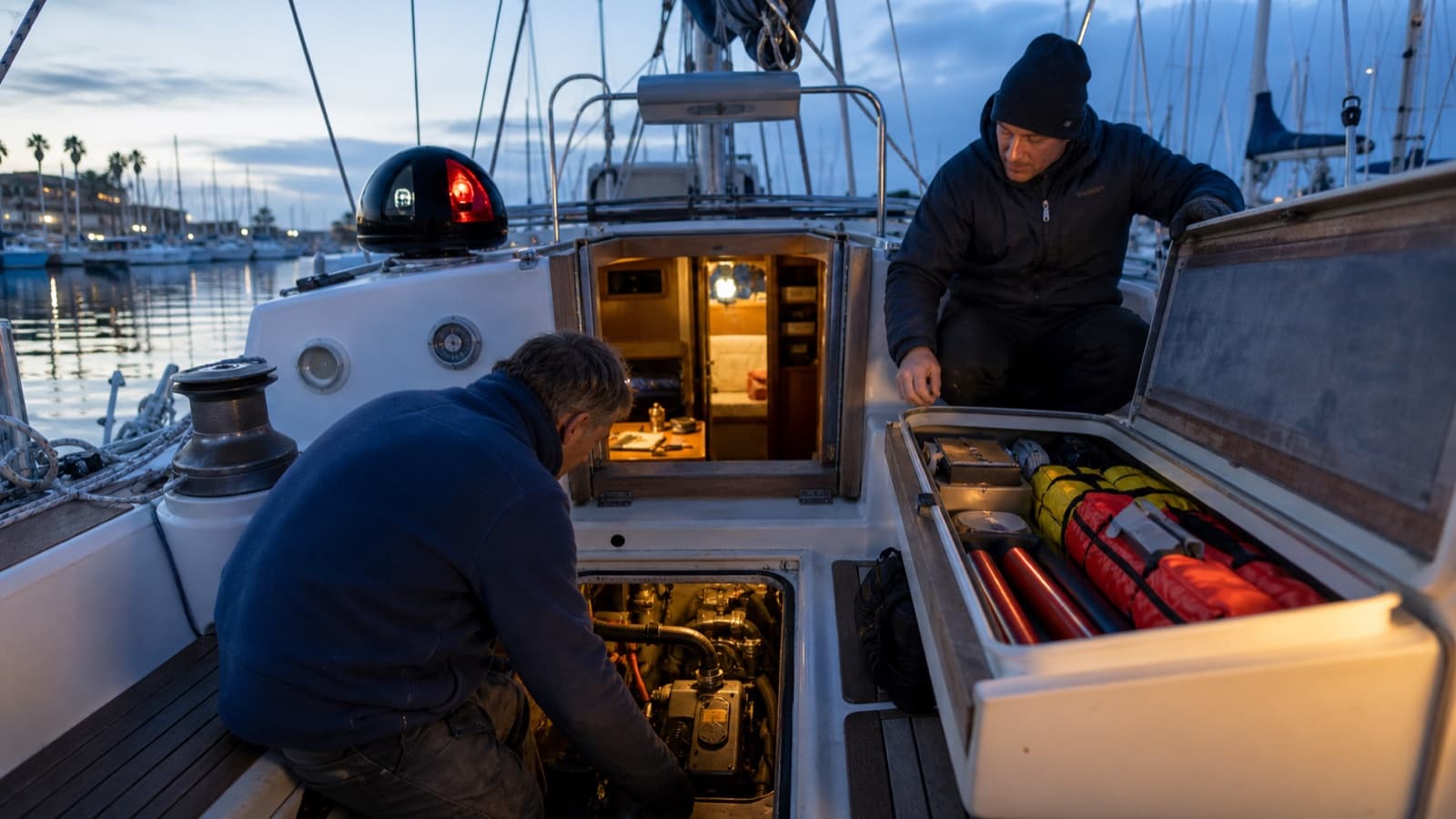
For an inboard, inspect the seacock position, sea strainer, hoses, clamps, raw-water pump history, heat exchanger, coolant, belts, and exhaust water flow. For an outboard, inspect intakes, telltale behavior, recent pump service, thermostats or pressure-control history, and the normal temperature range. Follow the exact manual because cooling layouts differ.
Salt trails, dried coolant, rust at a hose end, loose clamps, belt dust, or a temperature that slowly climbs under load deserves attention. A repair should be verified at the operating condition that produced the problem. Do not use an offshore departure as the first full-load test after cooling work.
Verify power, steering, and bilge systems
Test battery capacity and charging rather than relying on resting voltage. Inspect battery restraints, terminals, grounds, bank switches, alternator belts where fitted, and critical circuit protection. Start the engine while navigation equipment is operating and investigate resets, dimming, or low-voltage alarms before the trip.
Operate steering and controls through their normal range, check hydraulic fluid and visible components, and verify automatic and manual bilge-pump operation without polluting the harbor. Know which loads remain active with the main switches off and make sure the boat can support its essential electronics for the planned operation.
Use a shakedown run to establish confidence
Load the boat as it will be used and run locally at cruise, not only at idle. Monitor RPM, speed, temperature, voltage, oil pressure where available, smoke, vibration, steering, and any fuel-pressure or engine data supported by the vessel. Confirm that the propulsion system reaches its specified operating range.
After returning, reopen the machinery space and inspect fluid levels, clamps, filters, bilge condition, battery connections, belt dust, and heat. A small seep or loose terminal discovered at the home slip is valuable information. Resolve it and repeat the relevant test rather than accepting a temporary tightening as the final proof.
Make a fresh departure decision
Use current official marine forecasts, observed conditions, harbor information, and notices. The marina's interior water does not show the complete conditions outside the entrance or across the channel. Share a float plan, test VHF communications, verify required safety equipment, and ensure another responsible person understands the boat's essential systems.
This article addresses mechanical preparation, not navigation or weather routing. The operator is responsible for the voyage. If a warning, leak, power loss, uncertain fuel condition, or unfavorable forecast remains, postpone. The least expensive offshore problem is the one corrected before the boat leaves Marina del Rey.